Why It’s Worth Hearing the Strongest Objection to What You Believe
The argument nobody actually made
Most online arguments about God go like this. Someone describes the other side in the silliest possible way, defeats that version in three sentences, and collects a round of applause from people who already agreed. The other side does the same in return. Everyone leaves exactly where they started, just a little more irritated.
Philosophers have a name for the fix: steelmanning. Instead of attacking the weakest version of a view (the straw man), you build the strongest, most generous version you can, the one its smartest defenders would recognise, and engage with that.
Why this matters for believers
If you believe in God, it can feel risky to look hard at the best objections. What if they win? But a faith that has only ever met weak arguments hasn’t really been tested. It’s a bit like being undefeated at chess because you only play your nephew.
The Bible itself is surprisingly open to this. Job spends chapters accusing God of injustice, and the book keeps every word. The Psalms contain complaints that would get you a worried look in most church small groups. 1 Peter 3:15 asks believers to give a reason for their hope “with gentleness and respect,” which is hard to do if you’ve never listened to the other person’s best reason.
Why this matters for skeptics
The same goes the other way. If you’ve rejected faith, it’s worth asking whether you rejected the strongest version of it or the version you met at fourteen. Plenty of thoughtful people, scientists and philosophers among them, believe for reasons that are more careful than a bumper sticker.
You don’t have to be persuaded. You only have to be fair. That’s a low bar, and yet most of the internet trips over it daily.
A worked example: children who suffer
Take one of the hardest questions there is: why would a good God allow children to suffer? The strongest objection isn’t “religion is silly.” It’s this: if an all-powerful, all-loving God exists, the suffering of innocent children seems to be exactly what such a God would prevent. No lesson learned, no free will defence, seems to justify a child’s cancer.
Christians have responded in several ways: that a world with real freedom and stable natural laws carries real risk; that the Bible doesn’t explain suffering away but shows God entering it, in Jesus; that hope looks forward to a restoration where harm is undone. Some find those responses meaningful. Others find they don’t carry the weight. Both reactions are honest, and both are worth hearing out.
Notice what happens when both sides are stated at full strength: nobody looks foolish. You just see two serious ways of facing a painful reality. That’s a much better place to start a conversation than a comment section.
Go deeper
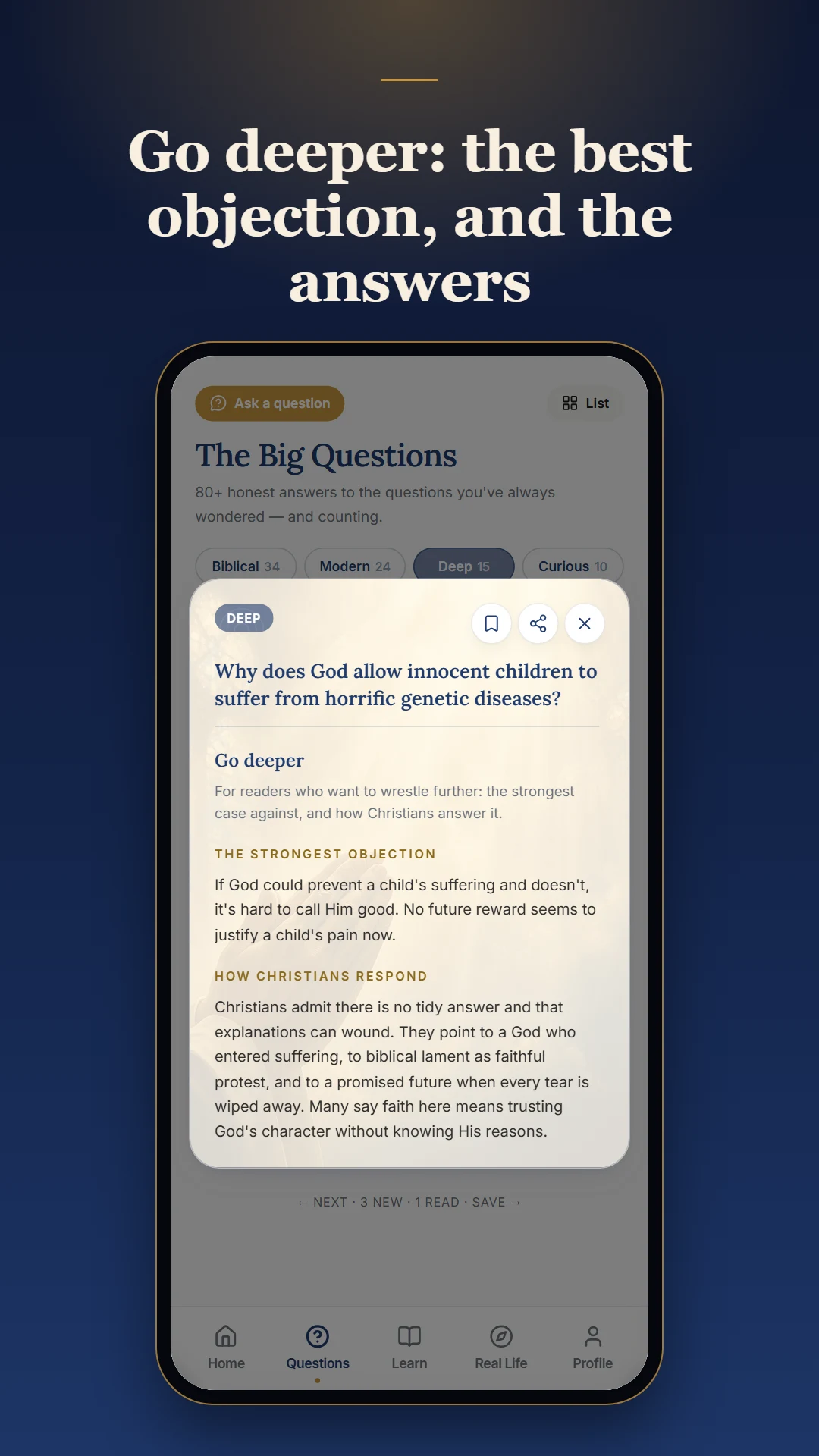
Many answers in Closer to God: Bible Questions include a Go Deeper section: the strongest objection to the answer, put plainly, and how Christians have responded. You get both sides and decide for yourself.
Get it on Google PlayHow to practise it (without a philosophy degree)
Try stating the other view so well that someone who holds it would say “yes, that’s exactly it.” If you can’t, you probably don’t understand it yet, which is useful information.
Separate the idea from the loudest people who hold it. Every worldview has fans you’d rather not sit next to at dinner.
Allow “I don’t know” as a real answer. On the biggest questions, it’s often the most honest one, and it tends to make the other person relax rather than reach for ammunition.
Where this leaves you
This isn’t about getting you to believe anything. It’s about holding your view, whatever it is, with open hands: strong enough to explain, loose enough to keep listening. You might end up more convinced. You might end up less. Either way, you’ll understand why, and you’ll be much better company in a conversation about God.